Abstract:
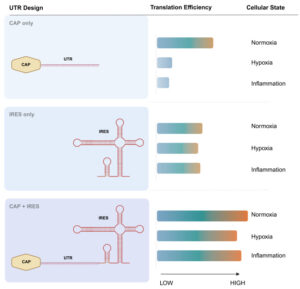
mRNA vaccines have revolutionized infectious disease prevention, yet they face a fundamental limitation: their exclusive reliance upon cap-dependent translation to express antigen. This mechanism of translation can become severely compromised under physiological stress conditions that are commonly induced at vaccination sites. In this issue of Molecular Therapy Nucleic Acids, Seo et al.1 present a solution by demonstrating that a SARS-CoV-2-derived internal ribosome entry site (IRES) element can enable continued protein expression under hypoxia and inflammation (Figure 1). Remarkably, lipid nanoparticle (LNP) vaccines containing this viral element, but synthesized without expensive nucleotide modifications, generated immune responses equal to or exceeding those of current clinical vaccines. These findings challenge the current paradigm that requires expensive nucleotide modifications for effective mRNA vaccines. More broadly, it provides an example of how viral translation strategies could unlock new therapeutic potential for mRNA platforms.
Publication link
https://doi.org/10.1016/j.omtn.2026.102969